HARKNESS
FELLOWSHIPS TRUST

Q&A: 2026 Harkness Fellow – Adam Allington

1. What is the central question behind the fellowship?
My starting point is: how do public management systems shape leadership behaviour, organisational performance and state capability in practice? Put simply, I am interested in whether the current “rules of the game” help or hinder the kind of leadership needed to make public services work under pressure.
A recurring concern is the gap between the capabilities we say we value – collaboration, innovation, long-term thinking and evidence-informed judgement – and the behaviours our systems may actually reward, such as staying within organisational boundaries, avoiding risk or focusing on short-term outputs. I want to identify the conditions that support judgement, learning, collaboration and mission focus, and the settings that unintentionally create fragmentation, compliance, short-termism or risk aversion.
2. Why split the fellowship between Georgetown and Harvard?
Washington DC and Boston offer complementary vantage points. Georgetown and the wider Washington environment connect the research to government effectiveness, implementation, administrative reform, accountability and the lived reality of public institutions.
Harvard and the wider Boston academic community offer a strong setting to test the findings against ideas about public value, leadership, democratic governance and institutional renewal, and to bring the work together through focused writing.
3. How does the project fit the Harkness tradition?
What excites me about Harkness is the tradition of taking a New Zealand challenge overseas, learning with an open mind and returning with ideas that strengthen our institutions. Dame Karen Poutasi is a powerful example of public service leadership and system improvement with enduring impact.
I want to honour that tradition by being curious, generous and demanding about evidence, then translating the learning into something of practical value at home. This is a real passion for me, and I stand on the shoulders of amazing leaders I have learnt from and worked with, including those no longer with us.
4. Where does democratic renewal fit?
Public management can sound technical, but it has democratic consequences. Whether institutions ultimately deliver improvements, explain trade-offs, use evidence well, treat people fairly, learn from failure and maintain integrity all affect public trust and legitimacy.
The existing idea of administrative drag is useful here because it names something many public servants recognise: the way process, reporting, approvals and assurance can each be justified on their own terms, but together can slow delivery and crowd out judgement, learning and responsiveness.
I am interested in how we reduce that drag without weakening integrity – better assurance, not simply more assurance. For me, democratic renewal is part of the same story: capable, trustworthy and responsive institutions that help democratic governments work better in a contested age.
5. What do you mean by a “contested age”?
By a contested age, I mean an environment where public institutions are operating under simultaneous pressure from rising public expectations, fiscal constraint, technological change, complex social challenges, declining trust and more intense scrutiny. The work of government is not simply becoming harder in a technical sense; it is becoming more contested in terms of legitimacy, evidence, values, trade-offs and confidence in institutions.
That matters for public management because leaders are being asked to deliver better outcomes, demonstrate value for money, manage risk, collaborate across boundaries and maintain public trust – often at the same time. My interest is in whether the systems around leaders help them exercise judgement and build capability in that environment, or whether they add friction, narrow choices and make it harder to focus on long-term public value.
6. How has your career shaped the research?
I have worked across policy, monitoring, strategy, planning, performance, governance, investment, data and insights in both social and economic policy areas. Those roles have shown me the same issue from different angles: a policy can be analytically strong but hard to implement; a performance measure can create focus but also distort behaviour; and evidence can illuminate a choice without making the judgement for you.
At Oranga Tamariki, those questions are especially real. The most important patterns for children and families can emerge over years and generations, and no single organisation can solve them alone. Good systems need to help leaders connect strategy to delivery, learn from evidence, share insight across government, iwi and community partners, and stay focused on whether choices are improving outcomes. The aim is not more reporting for its own sake. It is better learning, clearer choices and stronger accountability for public value.
7. What does “practically grounded” mean for the project?
It means testing ideas against real decisions, real constraints and real organisational behaviour. I expect to use interviews, comparative cases, practitioner discussions and focused analysis to ask not only whether an idea is attractive, but what it changes in practice, what conditions it depends on and what unintended effects it may create.
I want the outputs to be usable: case studies, leadership material, seminar content and practical propositions for current and future public service leaders, and the people who design performance, accountability, funding and assurance systems. With a colleague at DPMC, I recently founded HeadSPAN – an informal network for the Heads of Strategy, Performance and Accountability across the public service, to learn and support one another. So, I’ll be bringing what I learn back there.
8. Who has helped shape your thinking so far?
I am grateful to academics and practitioners who have generously shared their thinking as the proposal has developed, including Dan Honig, Mark Moore, Danielle Allen, Leonard “Dutch” Herman, Alisdair Roberts and Jon Gould.
The generosity has included thoughtful challenges, introductions and, in some cases, offers to share office space. Those conversations have helped me sharpen both the intellectual scope and the practical design of the fellowship.
I hope the final programme will continue in that spirit: not simply observing US institutions, but exchanging ideas and contributing a New Zealand perspective.
9. What US lessons are most likely to translate to Aotearoa?
I am not looking for a model to import wholesale. The most useful lessons may be about conditions and trade-offs: how decentralisation changes accountability, how data sharing and AI affect judgement, how independent public services maintain capability, and how institutions connect evidence, leadership and delivery.
The value lies in understanding innovations and failures, then asking what they reveal about New Zealand’s own context.
10. What are you most looking forward to from your time in the USA?
Honestly, the chance to think deeply, research and write. Senior public service roles are full of urgent and important demands, so protected time to follow a question carefully is rare.
I am also excited to spend time with academics, practitioners and public leaders who think deeply about these issues every day, to experience Washington and Boston as working cities, and to be in the United States at an important moment in global history, including during the midterm elections. Seeing democratic institutions, political debate and public administration up close during that period will be fascinating context for the research.
I have some family in the States I am hoping to see too, and it would be special to experience my first Thanksgiving with them. And if the programme leaves room for a few excellent bookshops, museums and concerts, even better.
From Wellington to Washington D.C. and Boston: Kiwi leader to explore how public services can build capability, perform, and renew trust
2026 Harkness Fellow Adam Allington will divide his United States programme between Georgetown University and Harvard University, connecting democratic renewal and public management research with the practical realities of leading inside government.
Adam Allington, General Manager Strategy, Insights and Performance at Oranga Tamariki – Ministry for Children, has been named the 2026 New Zealand Harkness Fellow.
His project, Enabling Public Service Leadership and State Capability in a Contested Age, will examine how public management systems shape leadership behaviour, organisational performance, state capability, public value, trust and democratic renewal.
“The question at the heart of this research is a simple one: are our public management systems helping leaders perform under pressure, deliver outcomes for New Zealanders, and build the trust and capability our future public services need?”, Allington says.
Washington will provide a close view of government institutions, implementation, accountability and administrative reform. Boston will create space to test the findings against scholarship on public value, leadership, democratic governance and institutional renewal, while consolidating the research and writing.
Allington has spent his career connecting ideas and implementation. His work has ranged across policy, monitoring, organisational strategy, system performance, governance, and investment. At Oranga Tamariki, he leads strategy, enterprise planning and performance, data, research and insights, and has acted as Deputy Chief Executive, System Leadership.
The practitioner-researcher
That experience has made the research personal and professional. In a department working with some of New Zealand’s most complex and consequential issues, the distance between a well-designed framework and a better outcome for a child can be considerable. Leaders must connect strategic direction with policy, evidence, investment, performance and frontline reality, while making decisions amid scrutiny, risk and competing time horizons.
Allington describes himself as a practitioner-researcher. He wants the fellowship to bridge academic work and the practical day-to-day choices faced by people leading public organisations.
“We talk a lot about adaptive leadership, collaboration, innovation and evidence-informed practice. But leaders do not operate in a vacuum,” he says.
“They operate inside systems of funding, accountability, risk, reporting and assurance. My research is about how we support leaders to create maximum public value within those realities, while evolving the system itself to enable the leadership that 21st century public service demands.”
“The value of the US comparison is not that New Zealand should copy it, but that its different scale and context offer rich lessons – innovations and failures – about how public services can perform better and build trust,” Allington adds.
Practical outputs
The project builds on emerging work by the Public Service Commission to define executive leadership capability, while looking more deeply at the system settings that enable capability in practice.
Aphra Green, Harkness Fellowships Trust Chair, says Allington’s project impressed the selection panel with its focus on enabling public servants to make the most of the resources at their disposal.
“We are excited to see what Adam’s research efforts in the US reveal that could apply to Aotearoa, and it is our pleasure to support another fellow to spend time engaging with leading American institutions and thinkers on issues central to the future of public service leadership,” she says.
The intended outputs are deliberately practical: applied case studies, practitioner-focused material, leadership resources, seminar content and a paper on implications for New Zealand public management. The fellowship will also provide foundations for longer-term academic research and writing.
Heather Baggott, Harkness Fellowships Trust Board member and Deputy Public Service Commissioner, says the fellowship, valued at up to $60,000 and offered in partnership with the Leadership Development Centre, continues to attract outstanding leaders working on issues central to the future of New Zealand’s public institutions.
“The project complements the Public Service Commission’s work on executive leadership capability by exploring the system conditions that enable leaders to put that capability into practice,” she says.
Allington says he is humbled and grateful to have been selected. “My sincere thanks to the Harkness Fellowships Trust Board for this extraordinary opportunity, to my sponsoring Chief Executive and colleagues at Oranga Tamariki for their support, and to everyone who has challenged and encouraged my thinking. I hope to honour their investment through the work I undertake and the lessons I bring home.”
Allington is expected to depart for the United States in October 2026 and return to New Zealand in January 2027. He will share lessons from the fellowship with New Zealand’s public sector community following his return.
Lessons from America: Hāpai Public article

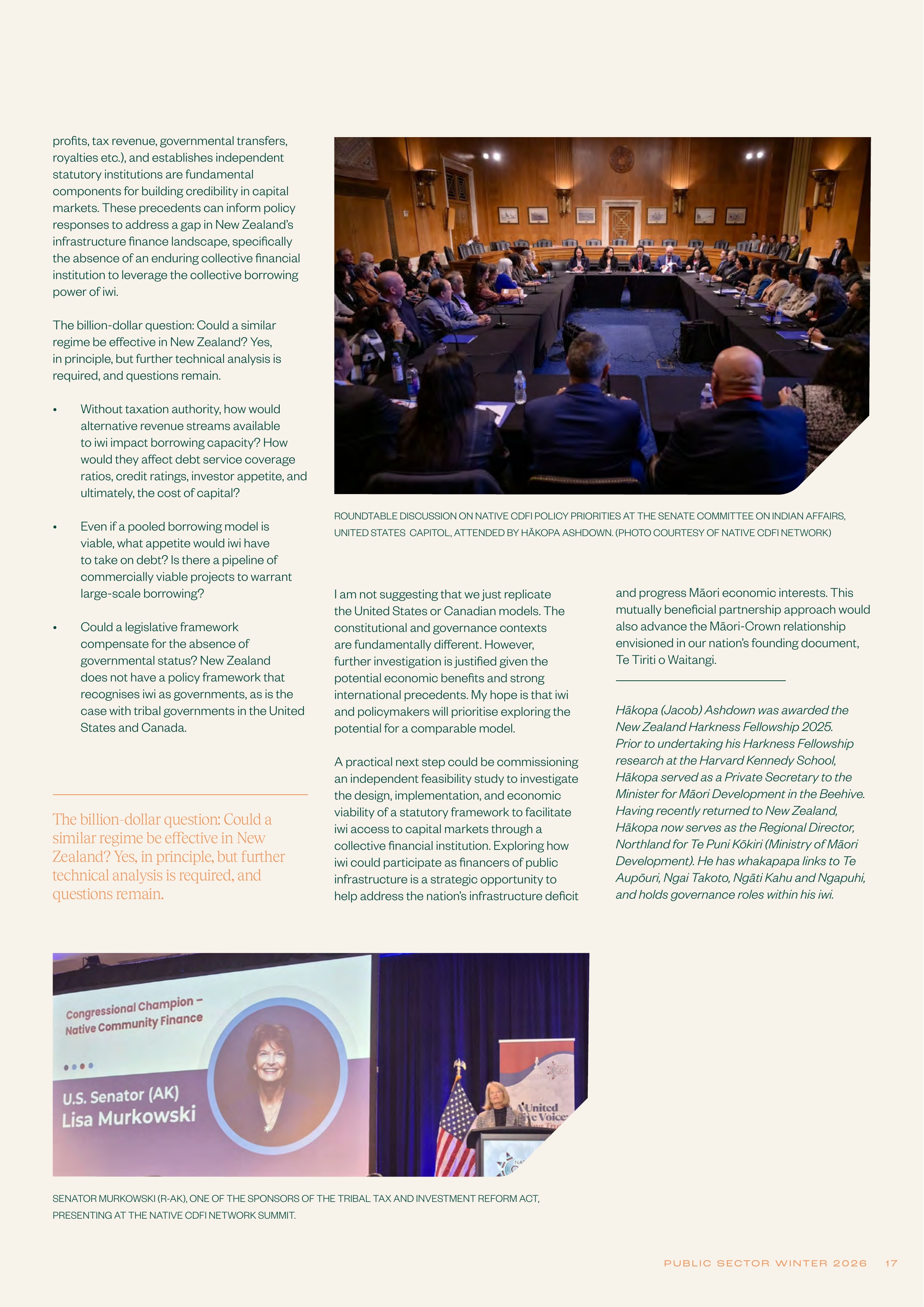
Read Hākopa’s reflections on what NZ can learn from the US in the Hāpai Public journal Winter edition.


